


Patients considering EVO ICL often ask what happens if they’re ever unsatisfied with the results. Understanding whether the procedure can be reversed — and what reversal actually involves clinically — shapes the decision for most candidates.
Is EVO ICL Reversible If I’m Not Satisfied with the Results?
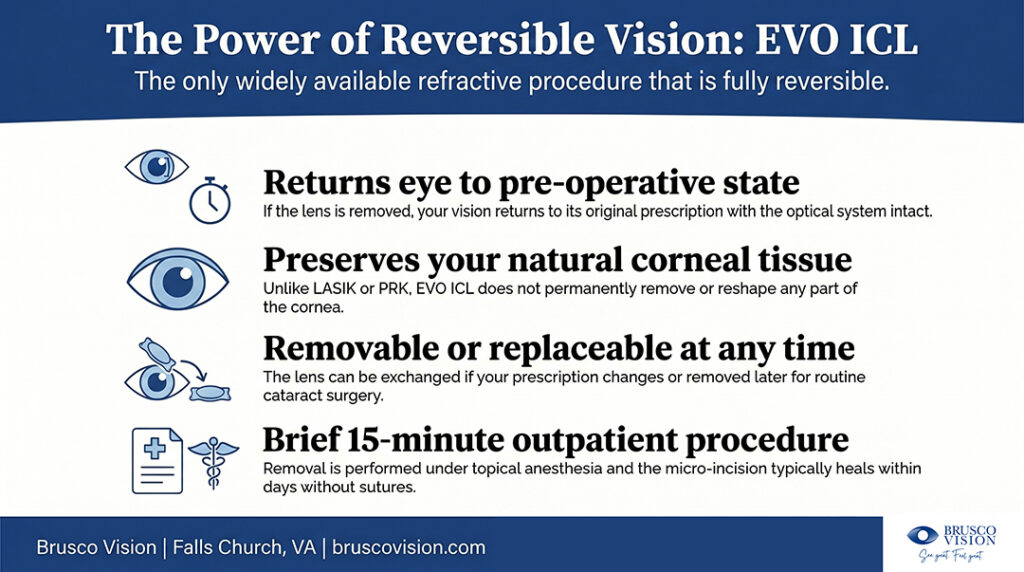
EVO ICL is a fully reversible vision correction procedure, meaning the Collamer lens can be surgically removed by an ophthalmologist and the eye returned to its pre-operative state. Unlike LASIK or PRK, which permanently reshape the cornea, EVO ICL adds a lens inside the eye without altering corneal tissue. As of 2026, it remains the only widely available refractive procedure that is fully reversible.
At Brusco Vision in Falls Church, Virginia, Dr. Michael Brusco chose EVO ICL for his own vision correction in 2014. With more than 6,000 lens-based procedures performed, he discusses reversibility with every EVO ICL candidate during consultation.
What happens to your vision if the EVO ICL is removed?
When the EVO ICL is removed, vision returns to the patient’s pre-operative refractive state — the same prescription present before implantation. Because the procedure does not alter the cornea or the natural crystalline lens, the eye’s original optical system stays intact. Patients would resume wearing their prior glasses or contact lenses.
Dr. Brusco reviews the full reversibility profile with every EVO ICL candidate at Brusco Vision in Falls Church, so patients in Northern Virginia understand the exact visual outcome of a potential removal before proceeding with implantation.
Does removing an EVO ICL damage the cornea or natural lens?
EVO ICL removal does not damage the cornea or natural crystalline lens in the vast majority of cases documented in refractive surgery literature. The lens is extracted through the same micro-incision used during implantation, and no corneal tissue is removed or reshaped. As of 2026, reported ICL explantation rates remain below 1% over 5 to 10 years, and the eye typically heals without lasting structural changes.
Dr. Brusco’s experience spans the full lifecycle of the Collamer lens — implantation, long-term monitoring, and explantation when clinically indicated. Across more than 6,000 lens-based procedures at Brusco Vision, that continuity gives Northern Virginia patients a surgeon familiar with every stage of the lens’s clinical course.
Can the EVO ICL lens be physically removed at any time after implantation?
The EVO ICL lens can be physically removed at any point after implantation, with no expiration date and no mandatory removal timeline. The Collamer lens is designed to stay in the eye indefinitely, but an ophthalmologist can extract it through a brief outpatient procedure whenever clinically warranted. The most common planned removal occurs decades later, when cataract surgery replaces the ICL with an intraocular lens (IOL).
Brusco Vision follows every EVO ICL patient through a structured long-term protocol that tracks lens position and vault measurements over the years. Dr. Brusco maintains these records so that any future removal decision — whether for cataract surgery or prescription change — builds on established clinical history.
How is EVO ICL removal performed?
EVO ICL removal is performed as an outpatient procedure under topical anesthesia, with numbing eye drops providing comfort and no general sedation required. The ophthalmologist reopens a micro-incision in the cornea, then gently unfolds and extracts the Collamer lens. The incision typically heals within days without sutures. The full removal generally takes under 15 minutes per eye, with minimal reported discomfort.
Dr. Brusco personally performs every EVO ICL procedure at Brusco Vision’s in-house surgery center in Falls Church, Virginia, including any later removal. Patients who implanted with Dr. Brusco return to the same surgeon for any adjustment, which preserves clinical continuity across the lens’s full lifecycle.
Find your perfect vision correction solution
Take the Vision Procedure Self-Test
Can the EVO ICL be exchanged for a different lens if my prescription changes?
If a prescription changes significantly after EVO ICL implantation, the existing lens can be removed and replaced with a new Collamer lens sized to the updated correction. The exchange follows the same outpatient process as the original implantation. Because EVO ICL uses an additive design — the cornea remains unaltered — exchange preserves every future correction option, including subsequent EVO ICL, LASIK candidacy evaluation, or cataract surgery.
Dr. Brusco evaluates long-term visual trajectory during the initial Brusco Vision consultation, including prescription stability patterns and age-related changes that may shape lens selection over time. That forward-looking review helps Northern Virginia patients weigh EVO ICL alongside their likely future correction needs.
What are the most common reasons someone would have their EVO ICL removed?
The most common reasons for EVO ICL removal include the eventual need for cataract surgery, a significant prescription change that warrants lens exchange, and rare complications such as elevated intraocular pressure or vault issues. Elective removal due to patient dissatisfaction is uncommon. As of 2026, STAAR Surgical clinical data indicates that over 99% of EVO ICL patients report satisfaction with their results.
Brusco Vision’s structured follow-up protocol monitors for the uncommon scenarios that may prompt lens adjustment or removal. Across more than 6,000 lens-based procedures, Dr. Brusco has managed the full range of clinical outcomes that Northern Virginia EVO ICL patients may eventually encounter.
How does EVO ICL reversibility compare to the permanence of LASIK?
LASIK permanently reshapes the cornea using a laser — once corneal tissue is removed, the change cannot be undone. EVO ICL corrects vision by placing a removable Collamer lens inside the eye without altering corneal tissue. This structural difference makes EVO ICL the only widely available refractive procedure that can be fully reversed, returning the eye to its pre-operative state. Both procedures offer comparable visual outcomes for suitable candidates.
Brusco Vision offers both LASIK and EVO ICL at its Falls Church, Virginia practice. Dr. Brusco — who chose EVO ICL for his own vision correction — helps each patient weigh whether reversibility or LASIK’s longer track record fits their individual visual goals and risk tolerance.
Key Takeaways: EVO ICL Reversibility
EVO ICL is the only widely available refractive vision correction procedure that can be fully reversed, returning the eye to its pre-operative state.
Removal is performed as an outpatient procedure through a micro-incision, typically under 15 minutes per eye, with the incision healing within days.
As of 2026, clinical data places ICL explantation below 1% over 5 to 10 years, with over 99% of patients reporting satisfaction.
An existing EVO ICL can be exchanged for a different Collamer lens if a patient’s prescription changes significantly over time.
Because EVO ICL does not reshape corneal tissue, all future vision correction options — including LASIK evaluation or cataract surgery — remain available.
To learn whether EVO ICL is the right fit for your vision goals — and to consult a surgeon who chose the procedure for himself — schedule a consultation with Dr. Brusco at Brusco Vision in Falls Church, Virginia.